 Top Trending
A Mushroom Powder for the Morning Coffee: 500 Milligrams of Lion's Mane per Scoop
Focus Mushroom Blend is a two-gram scoop of organic powder from Four Sigmatic of Santa Monica: lion's mane, cordyceps, cacao, bacopa, rhodiola and vitamin B12, stirred into coffee, with no caffeine of its own. I read every line.

This is a paid advertisement. Sponsored by Four Sigma Foods, Inc. (Four Sigmatic).

Raymond Pike is the pen name of this desk.
This page quotes no customers, because the reviews shown on the seller's product page belong to the whole store and none of the ones I could read names this powder.
Everything about the bag, from the six lines on the panel to the return terms, comes from the seller's own label and pages, read on September 9, 2026.
I've made the same cup of coffee at the same counter for thirty years, and I'm suspicious of anything that wants to get into it.
So when a pouch of mushroom powder turned up beside the coffee in two different places in one month, a shelf at the grocery store and a neighbor's kitchen, I bought a bag and read it the way I'd read a contract.
The short version: six lines on the panel, no caffeine, one line at a sixth of its trial dose, one at two thirds, one at a dose from a study of clinicians on night duty, one at two hundred times a day's need, and two with no memory trial at all.
That isn't a verdict.
It's an inventory.
The verdict takes the rest of this page, and it includes the part most pages about mushroom powders skip: what you can and can't send back.
Three-quarters of a tablespoon, two grams, once a day, stirred into whatever you already drink. Every number on this page is for that scoop.
Here's what the bag is.
Focus Mushroom Blend, from Four Sigmatic, the trade name of Four Sigma Foods, Inc., a company with its office in Santa Monica, California.
A resealable pouch of thirty scoops, thirty days if you take one a day.
The panel, in the seller's order: vitamin B12, organic lion's mane extract, organic cordyceps extract, organic cacao powder, organic bacopa extract, organic rhodiola extract.
Then one "other ingredient": organic blueberry powder.
Five calories.
Two grams of carbohydrate.
No caffeine.
I did what I always do.
I read the label before the listing.
I read the trials behind each line, at the doses they actually used, in people as old as I am when such trials exist.
I read the return page twice, because it says something the listing doesn't.
And I went looking for reviews of this bag on the seller's page and found reviews of the seller's coffee instead.
What I found is a well-made powder from a company with an address and a phone number, six lines that are all real, none of them at the dose of the trial that made it famous, and a return policy that only wants the bag back if you never opened it.
The Small Slips Every Man Past Sixty Knows by Heart
Before the pouch, let's talk about you for a minute.
Because you didn't click on a mushroom powder for the mushrooms.
You know the moments I mean.
A name you've known for twenty years sits on the tip of your tongue at the hardware store, and it won't come out until you're back in the truck.
You read the same paragraph of the paper twice.
The second time, it finally lands.
You walk into the garage with a clear purpose.
Then you stand there looking at the shelves, waiting for the purpose to come back.
You tell a story at dinner and stop halfway, because you can't remember whether you've already told it to these people.
Your wife says you have, and she's usually right.
You put the reading glasses down somewhere sensible.
Twenty minutes later, you find them on your head.

Sound familiar? It's one of the most ordinary things in the world.
I've had each of those this month.
None of them was a big deal.
It's a small snag in an otherwise good day, and most of the time it sorts itself out by lunch.
But it's annoying, and it's fair to want your mornings a little sharper.

So is this just part of getting older?
For most of us, mostly, yes: a full head, a short night, a name you don't use often.
Is it worth mentioning to anyone?
If it's changing quickly, or someone close to you noticed it before you did, yes, and that's a short conversation with your own clinician.
This page is about the everyday kind.
The name at the hardware store, the paragraph you read twice, the garage.
And about whether a scoop in your coffee deserves a place in that picture.
I'll tell you what it is, what's been studied, and where it falls short, and you can decide.
Why Another Cup of Coffee Only Goes So Far
So what do most of us do on a foggy morning?
We pour another cup.
Coffee is a fine habit, and I'm not about to take yours away.
But a second or third cup buys you alertness, not a name, and there's a ceiling on how much of it makes sense.
The FDA puts that ceiling at about 400 milligrams of caffeine a day for most healthy adults, roughly two to three 12-ounce cups of brewed coffee. [1]
Past that, the same agency lists the jitters, a faster heartbeat, an upset stomach and a poor night.
So "more coffee" runs out of road fairly quickly.
The other usual answers are good ones.
A crossword, a walk after breakfast, a glass of water before the second cup, a list stuck to the fridge.

I do all of them, and I'd tell you to keep doing all of them.
They cost nothing, and nothing in a pouch replaces them.
Isn't a crossword enough, then?
It's a fine habit, and I'd never talk you out of it; it just happens on the quiet mornings, not the busy ones.
And the list on the fridge?
Keep it, because a list catches the errand.
It won't find the name at the hardware store, and nothing on this page claims to either.
Then why look at a scoop at all?
Because a lot of men want one more small thing in a routine they already keep, and the morning cup is the one routine nobody skips.
That's the honest pitch for a powder like this one.
Not a new life, just a scoop in a cup you were going to drink anyway, every day, without having to think about it.
The easiest habit to keep is the one you never have to remember. Nobody forgets the coffee.
So the real question isn't whether a scoop sounds nice.
It's what's in it, how much, and what's been studied, and that's what the rest of this page is for.
A Pouch, a Two-Gram Scoop, and a Panel With Six Lines
Here's the pouch, described the way you'd see it on your own counter.
An orange pouch with a zip seal, about the size of a paperback, with a small scoop inside.
The front says Focus and names three of what's inside: lion's mane, cordyceps and B12.
The back is the panel, and I'll read it to you per scoop, three-quarters of a tablespoon, two grams:
Vitamin B12, as cyanocobalamin, 500 micrograms, which the panel itself prints as 20,833 percent of the Daily Value.
Organic lion's mane extract, from the fruiting body, 500 milligrams.
Organic cordyceps extract, from the fruiting body, 250 milligrams.
Organic cacao powder, 300 milligrams.
Organic bacopa extract, from the leaf, 200 milligrams.
Organic rhodiola extract, from the root, 250 milligrams.
Other ingredient: organic blueberry powder.
The directions are one sentence: add a scoop to your coffee, tea or smoothie.
The seller says the flavor is light and smooth, and I'd agree; in black coffee it tastes faintly of cocoa and of nothing else.
There's no caffeine in the scoop.
Whatever wakes you up in that cup was in the cup before the scoop went in.

Is it fiddly to use?
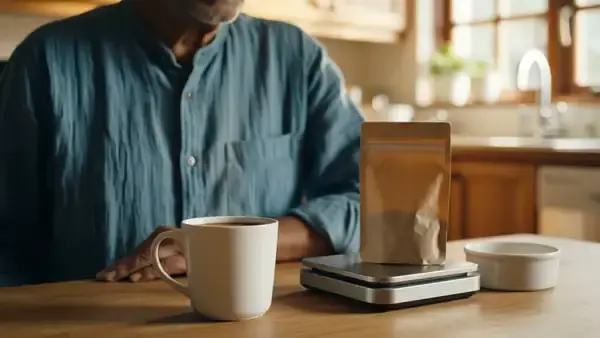
No: you open the pouch, level the scoop, tip it in and stir, and it's done before the toast pops.
Will it change my coffee?
Not much, and that's the point: a hint of cocoa, and a few specks that settle at the bottom of the cup.
What does the seller say it's for?
Focus, in its own words, and the pouch makes a few bigger claims on the front that I won't repeat, because the panel is the part you can check.
Lion's Mane: Five Hundred Milligrams, and the Trial That Used Three Point Two Grams
The line the whole pouch is known for, and the line with the best-known trial in people my age.

What is it, in plain words?
An edible mushroom with long white spines that grows on old beech and oak trees, eaten as food in East Asia and, more and more, here.
Has anyone tested it in people over fifty?
Yes, in one small trial that's been read many times.
Thirty-one Japanese adults over 50 took a daily preparation of the dried fruiting body, 3.2 grams a day, or a placebo, for twelve weeks.
The lion's mane group scored higher on a standard mental-status test than the placebo group, and the difference faded in the weeks after they stopped. [2]
Three point two grams a day.
The scoop holds 500 milligrams of extract, from the fruiting body, which is the right part.
Why does "fruiting body" matter?
Because it's the mushroom itself, the white shaggy part you'd see on the log, and it's the part the Japanese trial dried and used. [2]
Some powders on the shelf are grown on grain and sold with the grain in them.
The seller says this one uses log-grown fruiting bodies with no fillers, grains or carriers, and that's a point in its favor.
That's a sixth of the trial's daily amount, in a cup, and the trial was in people who took tablets three times a day for twelve weeks.
There's a second study, in younger people, that's honest to mention.
Forty-one healthy adults aged 18 to 45 took a single 1.8-gram dose or a placebo, and the lion's mane group was faster on an attention task an hour later; after 28 days at that dose, the other tests showed nothing clear. [3]
One point eight grams, once.
The scoop is a little over a quarter of that.
Lion's mane at 500 milligrams is a real amount of a real mushroom, and it sits at a sixth of the dose that produced the only twelve-week result in people over 50.
Bacopa: Two Hundred Milligrams, and Three Trials That Used Three Hundred
The line with the most trials in people over 55, and a dose that falls just short of them.
If I had to pick the line in this pouch worth paying attention to, it's this one.

Bacopa monnieri is a small creeping plant of wet ground in India, used there for centuries.
Fifty-four healthy adults aged 65 and older took 300 milligrams a day of a standardized extract, or a placebo, for twelve weeks, and the bacopa group did better on delayed word recall. [4]
Ninety-eight healthy adults over 55 took the same 300 milligrams for twelve weeks, and the bacopa group did better on verbal learning and retention. [5]
A 2014 meta-analysis pooled nine trials of standardized extracts, 518 people, taken for at least twelve weeks, and found faster performance on two measures of attention and processing. [6]
Why does everyone keep saying twelve weeks?
Because that's how long those trials ran before they measured anything, so a week or two tells you about the taste, not the bacopa.
Three hundred milligrams, of a standardized extract, for twelve weeks.
The scoop holds 200 milligrams of an organic extract, and the panel doesn't say what it's standardized to.
Two thirds of the trial dose, of an extract whose strength isn't printed, in a cup.
Closer than the mushroom, and still not the trial.
Bacopa is the line I'd have put first. At 200 milligrams it's two thirds of the way to the trials in people over 55, and the trials took twelve weeks to show anything.
Rhodiola: A Root Studied in Clinicians on Night Duty
The line with a famous trial, and the trial least like your morning.
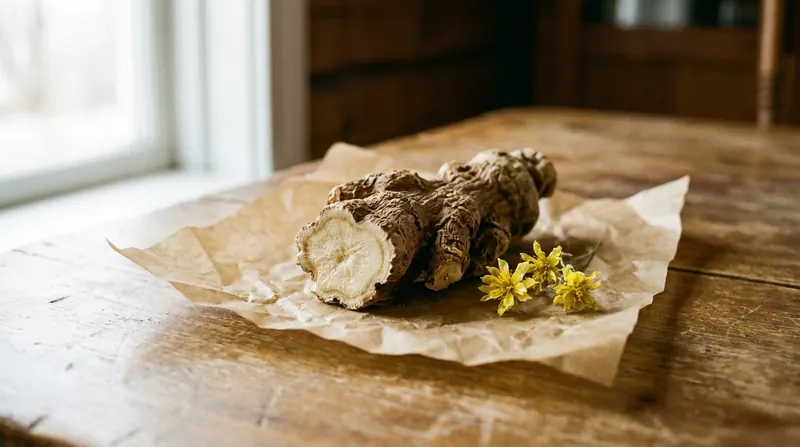
Rhodiola rosea is a root from cold mountains and the Arctic, with a rose smell when you cut it.
Its best-known trial gave 56 healthy young clinicians on night duty one tablet a day of a standardized extract called SHR-5, or a placebo, for two weeks each, and measured them at the end of the shift.
The rhodiola group did better on a set of tests of attention, short-term memory and speed than the placebo group, during the first two weeks. [7]
Young clinicians, at the end of a night shift, after two weeks.
The scoop holds 250 milligrams of an organic extract, and the trial extract was a standardized one with a name.
I'm not a young clinician and my coffee isn't a night shift.
The trial says what rhodiola did for tired people under pressure, and nothing about a man at his own counter at seven.
Rhodiola: one real trial, in very different people at a very different hour. It's a tiredness result, not a memory result.

Vitamin B12: The Biggest Number on the Panel
The first line on the panel, the biggest number on it, and the shortest section.
Five hundred micrograms of B12 is a lot.
The Daily Value printed on American labels is 2.4 micrograms, so the panel itself prints 20,833 percent. [8]
Is that too much?
The federal Office of Dietary Supplements says B12 has no set upper limit, because of its low potential for harm, and that the B12 in supplements skips a step that the B12 in food needs before the body can take it up. [9]
Then why not call it a memory ingredient?
Because a 2018 Cochrane review of 14 trials in 27,882 cognitively healthy adults found that B-vitamin supplements probably have little or no effect on overall thinking for up to five years. [10]
B12 is still a real thing to keep an eye on after 60, because the stomach absorbs less of it from food with age. [9]
If nobody has checked your level in a few years, that's a simple blood test and a clinician, not a scoop in your coffee.
Two hundred times a day's need is a number for the front of a pouch. For most men who aren't low, it isn't a memory ingredient.
Cordyceps, Cacao and a Pinch of Blueberry
Two lines I'd have left off a panel with "Focus" on the front, and the reason they're there.
Cordyceps militaris, 250 milligrams, is an orange club-shaped fungus grown commercially as a stand-in for the wild caterpillar fungus of Tibet, which is far too rare for a pouch.
The human studies I could find were about exercise, small and mixed, and I found no trial of cordyceps on memory or attention in healthy adults.
The seller lists it under "energy and endurance," which is at least the right shelf.
Cacao, 300 milligrams, is the ground seed of the cocoa tree, and it's the reason the scoop tastes of anything.
Three hundred milligrams of powder is a fraction of a square of dark chocolate, and I found no trial of cacao at anything like this amount on memory.
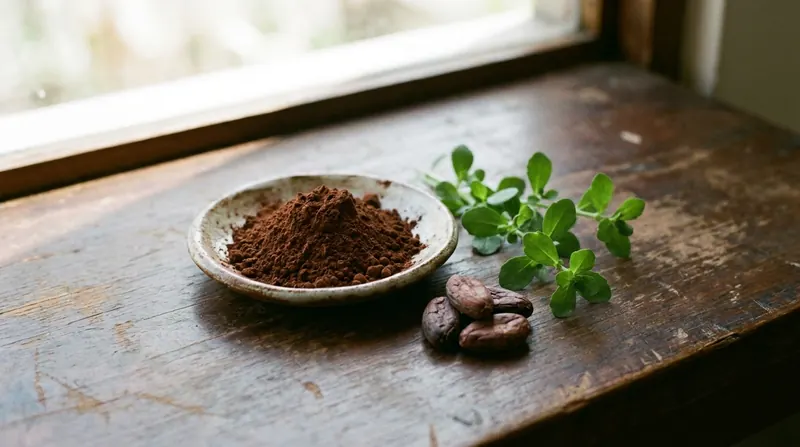
And the blueberry, which is on the panel as an "other ingredient" with no amount.
In one small study, 26 healthy older adults with an average age of 68 drank a daily blueberry concentrate providing 387 milligrams of the berry's purple pigments for twelve weeks, and showed more blood flow on a brain scan and a borderline change on one working-memory test. [11]
A blueberry powder with no printed amount, in a two-gram scoop, isn't that daily concentrate.
It's a color and a name, and a handful of real berries on your oatmeal is the better bet.
Cordyceps: an exercise ingredient with no memory trial.
Cacao and blueberry: flavor, and good company in the cup.
What's Been Studied, in Plain Words
Let me put the good news and the fine print side by side, because you deserve both.
Here's what the research on these ingredients has actually looked at.
- Lion's mane: in 31 adults over 50, 3.2 grams a day for twelve weeks went with higher scores on a mental-status test than placebo. [2]
- Bacopa: in adults over 65, 300 milligrams a day for twelve weeks went with better delayed word recall. [4]
- Bacopa again: in adults over 55, the same dose went with better verbal learning and retention. [5]
- Bacopa, pooled: nine trials, 518 people, faster on two measures of attention. [6]
- Rhodiola: in young clinicians on night duty, two weeks went with better scores on attention and speed tests. [7]
- Blueberry: in 26 older adults, a daily concentrate went with a borderline change on one working-memory test. [11]
That's a respectable list for a coffee add-in.
These are real ingredients with real studies behind them, and that's more than most pouches on the shelf can say.
Now the fine print, which is the same fine print I've been reading you all along.
Every one of those studies used more than the scoop holds, or different people, or a single ingredient on its own.
So what are you actually buying?
A daily dose of those same ingredients at smaller amounts, in a habit you'll actually keep, from a company that prints every number.
Nobody has tested this pouch itself. What's been studied is its ingredients, one at a time, and that's the honest way to read it.
What Sets This Pouch Apart From the One Next to It on the Shelf
I've been hard on the doses, so let me be just as fair about what Four Sigmatic gets right.
Because there's a lot on that shelf that gets less right.
Does it print every amount?
Yes, and that matters more than it sounds.
Plenty of powders hide their herbs inside a "proprietary blend" with one total weight and no breakdown.
This panel gives a number for every active line, so you can do exactly what I've done on this page: set each one beside its study.
Is it organic?
The pouch carries the USDA Organic seal, and every ingredient on the panel is listed as organic.
Where do the mushrooms come from?
The seller says the lion's mane and cordyceps are fruiting bodies grown on logs, not on grain, with no fillers or carriers.

Is there a real company behind it?
Yes: Four Sigma Foods, Inc., with an office in Santa Monica, a toll-free number, (855) 400-8584, and a support email, all printed on its own site.
Does it overpromise on the label?
The front of the pouch leans on bigger words than I'd use, and I've left them off this page.
But the listing also carries the standard sentence that its statements haven't been evaluated by the FDA, the same sentence every American supplement prints.
Weighed lines, organic ingredients, log-grown mushrooms and a company you can call. That's a better start than most pouches on the shelf.
A Normal Morning With the Scoop
So what would this look like in real life?
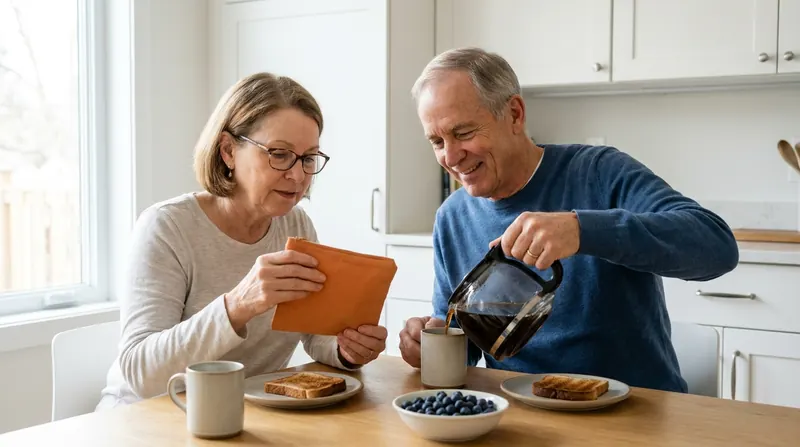
Here's a composite morning, built from the directions on the pouch and nothing else, not a customer's story.
Six forty-five.
The coffee's brewing, the paper's on the step, and the pouch is where the sugar bowl used to be.
You level a scoop, tip it into the mug and stir.
Ten seconds, and the cup tastes like coffee with a hint of cocoa.

You take it out to the porch, same as always.
Nothing about your morning has changed except the color of the cup.
Around ten, you write one line in a small notebook: what you were doing, and how it went.
Not "sharper" or "foggier," just the facts of the morning.
It feels a little silly the first week.
By the third, it's the part of the routine you'd miss.
In the afternoon, the usual: a walk, a glass of water, a phone call to your brother.
The scoop doesn't replace any of it, and it doesn't ask you to change any of it.
And the evening?
Nothing to take, nothing to remember, and nothing in the scoop to keep you up, because there's no caffeine in it.
One scoop, one cup, one line in a notebook. That's the whole routine.
What happens on day thirty?
You sit down with the notebook and a fresh cup, and you read thirty lines about your own mornings, the good ones and the ordinary ones.
Do that for thirty mornings and you'll know two things for certain: whether you like the taste, and whether you'll keep the habit.
Bacopa's trials ran for twelve weeks, so the third thing takes three pouches to find out.
Getting the Scoop Into Your Morning Without Thinking About It
The whole case for this pouch rests on one thing: that you'll actually use it every day.
So here's how to make that easy.
Where should the pouch live?
Right next to the coffee maker, not in the cupboard, because out of sight really is out of mind.
Hot coffee or iced?
Either, though it mixes more easily in hot; in iced coffee, stir it into a splash of hot water first.
What if I'm not a coffee man?
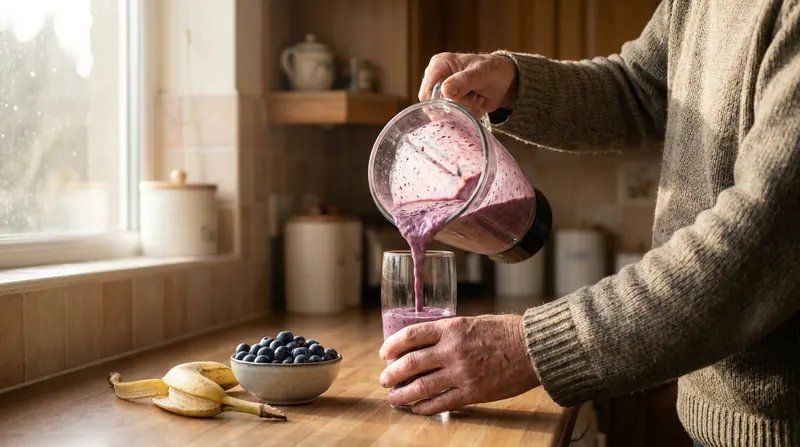
The seller says tea or a smoothie works just as well, and a smoothie with a handful of blueberries hides the specks completely.
Can I bake with it?
The seller suggests baked goods too, which is fine for flavor, but a daily test needs a daily scoop, and a muffin on Sunday isn't one.
Should I take two on a busy day?
The directions say one scoop, and that's the amount this page describes.
Two scoops still wouldn't reach any of the trials, so there's nothing to gain by guessing.
Same pouch, same spot, same cup, same hour. Make it boring, and it'll stick.
If You Do Buy It: One Bag, the Same Cup, Bacopa's Twelve Weeks, One Notebook
If you're going to spend the money, spend it as a test with a date on it, and test the line that has the best chance.
- Buy one bag first, not the bundle. Thirty scoops is the taste test, and the return window only covers a bag you haven't opened.
- Put the scoop in the same cup at the same hour every morning. Bacopa's trials took twelve weeks; a scoop on the days you remember won't test it.
- Keep the coffee exactly as it was. There's no caffeine in the scoop, so nothing about your morning should change except the color of the cup.
- Write one line a day in a notebook. Not "sharper" or "foggier." What you were doing at ten, and how it went.
- Take the pouch to the pharmacist before day one if you take anything daily. Bacopa and rhodiola are worth a minute at the counter.
- On day thirty, read the thirty lines and decide on the second and third bags that a twelve-week test would need.
Look at that list the way I do.
Four of the six things cost nothing.
The bag is the one you'll pay for, and the notebook and the same cup at the same hour are what turn it into a fair test.

Who It Suits, and Who It Doesn't
This is worth a look if:
- You already drink coffee or tea every morning and want a two-gram scoop of organic mushroom and herb powder in it, with no caffeine of its own.
- You want bacopa at two thirds of its trial dose in a form you'll actually take every day, because it's in a cup you were going to drink anyway.
- You want a company with a street address in California, a toll-free number and an email. You have all three on this page.
- You can hold two ideas at once: six real lines, none at the dose of the trial that made it famous.
- You'll run it as a twelve-week test with a notebook, not as a hope.
Give it a miss if:
- You want lion's mane at its trial dose. A scoop is a sixth of it; you'd need six scoops a day, and the bag would last five days.
- You want something that acts on a condition a clinician has named. This is a dietary supplement.
- You want a refund if you don't like the taste. Opened bags don't go back.
- You want customer reviews of this bag before you buy. The seller's page doesn't have any I could find.
- You take anything daily and haven't asked a pharmacist about bacopa and rhodiola. Ask first.
What the Scoop Isn't, So Nobody's Disappointed
I'd rather you read this list now than feel let down when the bag arrives from California.
- It isn't a wake-up. There's no caffeine in it; the coffee does that, with or without the scoop.
- It isn't the lion's mane of the trial. Five hundred milligrams is a sixth of the 3.2 grams a day that produced the twelve-week result.
- It isn't the bacopa of the trials either, though it comes closest: 200 milligrams against 300, of an extract whose strength isn't printed.
- It isn't medicine. It's a dietary supplement, and its own listing carries the sentence that says so.
- It isn't a B12 check. If you want to know your level, that's a blood test, not a scoop.
- It isn't returnable once it's open. The seller refunds unopened bags only, within 45 days.
What it is: a daily, weighed, organic scoop of real ingredients, in a habit you already have.
That's worth something, as long as you buy it for what it is.
If You're Reading This for Someone Else
A lot of pages like this get read by a wife, a daughter or a son before they get read by the man who'd drink the coffee.
If that's you, here's the short, fair version.
Is it a sensible gift?
For a man who drinks coffee every morning and likes a project, yes: it's a food-like powder with a printed panel, not a mystery.
What should I check first?
Whether he takes anything daily, because bacopa and rhodiola are worth a word with the pharmacist before the first scoop.
How many should I buy?
One, because an opened bag can't go back, and the taste is the first test he'll run.
And give him the notebook with it.
The pouch is the easy part. The same cup at the same hour, and one line a day, is what makes it a fair test.
Three Fair Objections: The Price, the Powder, and the Wait
I raised all three of these myself, reading the pouch at my own counter.
They're good objections, so let's take them one at a time.
"Thirty scoops for the price of a month of good coffee beans. Is that worth it?"
That's roughly what one bag costs on the seller's page, and it's a fair question.
Here's how I'd think about it.
You're paying for six weighed ingredients, organic, with the mushrooms grown on logs, from a company that prints its address and phone number.
You're not paying for the dose of any single trial.
If you want lion's mane at 3.2 grams a day, this isn't the bag, and no amount of scoops makes the math work.
"I don't like powders in my coffee."
Fair enough, and you'll know in one morning.
It doesn't dissolve completely, and a few specks settle at the bottom.
If that bothers you, the seller suggests tea or a smoothie, and a smoothie hides it best.

"Twelve weeks is a long time."
It is, and I won't pretend otherwise.
That's how long the bacopa trials ran, and it's three pouches.
If you're not willing to give it three months, save your money and keep the walk and the crossword.
"Isn't this just fancy cocoa?"
No, but it's a fair jab: the cocoa is the flavor, and the lion's mane, bacopa and rhodiola are the reason it costs more than cocoa.
If all you want is the taste, a spoon of cocoa powder is cheaper.
If you want the six weighed lines in a daily habit, that's what the pouch is.
"Why not just buy the bundle and save a little?"
Because an opened bag doesn't go back, and three bags of something you haven't tasted is a bet, not a test.
Buy one and taste it. Then decide on the other two.
From Santa Monica, California, With a Return That Only Takes Unopened Bags
The pouch is sold by Four Sigmatic on its own website, and that's the only place this page links to.

The company is easy to find.
Four Sigma Foods, Inc., trading as Four Sigmatic, with an office on Second Street in Santa Monica, a registered address in Delaware on its contact page, a toll-free number and a support email.
The pouch says the mushrooms are certified organic and grown on logs rather than on grain, which is more than most say.
The current price is shown on its page, not here.
The day I read it, one bag of thirty scoops cost about what a month of decent coffee beans costs, and the multi-bag bundles were a little cheaper per bag.
Now the two things that matter more than the price.
First, shipping: Four Sigmatic ships within the United States from its own store, and the shipping cost is shown at checkout.
Second, the return policy.
Read this part twice.
If you want to return a bag, you email the seller first, at the address on its return page, and wait for instructions.
The bag has to be unopened with the seal intact, and back at the seller's warehouse within 45 days of the purchase date.
The refund is the price of the bag minus a 3 percent processing fee and minus the original shipping, and you pay the postage to send it back.
There's no satisfaction promise: if you open it and don't like it, that's your bag.
It's a real refund with real conditions, and the biggest condition is the seal.
I'd rather say so plainly than call it a refund with no strings.
The ingredient guide linked at the foot of this page goes through every one of the six lines and the blueberry: what each ingredient is, and what the research does and doesn't show, at what dose.
It also covers what to be careful about, bacopa and rhodiola first, and it's written to print and take to the pharmacist if you take anything daily.
What Readers Ask Me Before Their First Bag
Questions readers ask
Is this medicine?
No. It's a dietary supplement, an organic powder of mushrooms, herbs, cacao and vitamin B12 sold in a resealable pouch.
Does it have caffeine?
No, the scoop has none of its own. Whatever wakes you up is the coffee or tea you stir it into.
Which line has the best research behind it?
Bacopa, at 200 milligrams against the 300 that twelve-week trials in people over 55 used.
What does it taste like?
Faintly of cocoa in black coffee. A few specks settle at the bottom of the cup.
Will it help my memory?
I can't promise that, and be wary of any page that does. The honest use is a twelve-week bacopa test in a cup you already drink, with a notebook.
Can I take it alongside what I already take?
Ask your pharmacist and take the ingredient guide with you. Bacopa and rhodiola are the two lines worth naming.
How long does a pouch last?
Thirty mornings at one scoop a day.
Is it organic?
Yes, the pouch carries the USDA Organic seal and every ingredient is listed as organic.
Who makes it?
Four Sigma Foods, Inc., trading as Four Sigmatic, with an office in Santa Monica, California and a toll-free number, (855) 400-8584.
Can I put it in tea instead of coffee?
Yes. The directions say coffee, tea or a smoothie.
Does it ship to me?
Within the United States, from the seller's own store. The shipping cost is shown at checkout.
What if I don't like it?
An unopened bag can go back within 45 days, minus a 3 percent fee and the original shipping. An opened bag can't.
Why You Won't Find Customer Reviews Here
The seller's product page shows a review counter with more than five thousand reviews on it.
I read the ones the page showed me, and they were about the seller's coffee, its creamer and its probiotic blend.
That counter belongs to the store, not to the bag.
I looked for a review that names Focus Mushroom Blend or its six ingredients and didn't find one in what the page loaded.
So this page quotes nobody.
I'd rather have no customers than borrow the coffee's.

So where do you get a real opinion?
Ask the neighbor who has a pouch, or the friend at the bench who's tried one, and ask him what it tastes like and whether he kept it up.
That's worth more than any counter.
And after thirty mornings, your own notebook is worth more than both.
Everything Above, in Sixty Seconds
- A pouch of thirty two-gram scoops from Four Sigmatic of Santa Monica, California: lion's mane 500 milligrams, cordyceps 250, cacao 300, bacopa 200, rhodiola 250, vitamin B12 500 micrograms, and a pinch of blueberry. Five calories, no caffeine.
- Lion's mane: a sixth of the 3.2 grams a day of the twelve-week trial in adults over 50. [2] Bacopa: two thirds of the 300 milligrams of the trials in adults over 55. [4] [5] [6]
- Rhodiola: a trial in young clinicians on night duty. [7] B12: Cochrane found nothing in people who aren't low. [10] Cordyceps and cacao: no memory trial.
- No customer reviews of this bag on the seller's page; the counter there belongs to the store.
- Ships within the United States; returns only of unopened bags within 45 days, minus a 3 percent fee and the original shipping, postage on you.
- The honest use: the same cup at the same hour for twelve weeks, a notebook, and bacopa as the line you're actually testing.

What a Scoop Is Actually Worth
Here's the whole thing in one breath.
Six real lines in a well-made pouch, from a company that prints every one of them and grows its mushrooms on logs.
None at the dose of the trial that made it famous.
Bacopa the closest, at two thirds.
No caffeine, five calories, and a taste of cocoa in a cup you were going to drink anyway.
And a return page that only wants the bag back with the seal on.
If you're a man who drinks coffee every morning and wants a daily two-gram scoop of bacopa and lion's mane in it, tested honestly over twelve weeks, that's worth one bag.
Not because of the front of the pouch.
Because you'll know exactly what's in the cup and what isn't.
I started this page suspicious of anything that wanted into my coffee.
I finish it thinking this pouch has earned a fair trial, on the terms I've laid out, and no bigger ones.
Would I buy it again?
I'd buy it for the bacopa and the habit, with my eyes open about the rest, and that's the only way I'd suggest you buy it too.
Buy one bag, not the bundle, put the scoop in the same cup at the same hour, and write one line a day for thirty days. The notebook is a better judge than I am.
One orange pouch, thirty mornings, from the company in Santa Monica
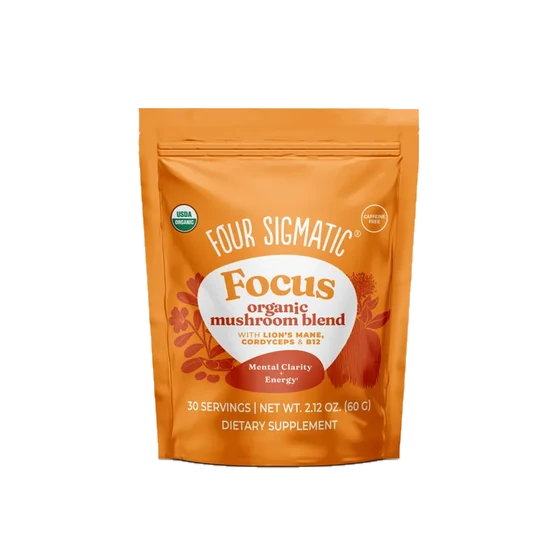
Three-quarters of a tablespoon of mushroom, cacao and herb powder stirred into your coffee, with no caffeine of its own, from a company in Santa Monica.
SEE THE POUCH AT FOUR SIGMATICSold and shipped within the United States by Four Sigma Foods, Inc. (Four Sigmatic), Santa Monica, California · Shipping cost shown at checkout · Returns only of unopened bags with the seal intact, within 45 days of purchase, after emailing the seller first; refund minus a 3 percent fee and the original shipping, with the return postage on you
P.S. If you take one thing from this page, take the two numbers.
Five hundred milligrams of lion's mane, a sixth of the trial.
Two hundred milligrams of bacopa, two thirds of it.
P.P.S. If the slips have been getting more frequent for a year, and they're there before the coffee too, talk to your own clinician before you buy anything.
A scoop in the morning cup is a small habit, and it was never meant to answer that question.
P.P.P.S. And if you do order it, keep the notebook, and keep the coffee exactly as it was.
When the bag is empty, you'll have thirty lines about your own mornings, and that's worth having whichever way they turn out.